A conversation with Henry Morales: “There’s no one mold of what Latinidad looks like.”
The Guatemalan-American artist talks about how his family’s daily life in the diaspora became the inspiration behind his latest exhibition, “Los de Aquí” (Those From Here).
By: Némesis Mora

STEPHEN KNIGHT
It had never crossed Henry Morales’ mind to become an artist. He thought he would dedicate his life to theater, which he had loved dearly since he was a kid. But life had other plans for him.
One day, while he was drawing during his break, the floor manager at his job noticed his artwork for the first time. Impressed, she exclaimed, “This is beautiful! You should go to school to study art.” Advice from outsiders often hits differently, and it did with Morales, who decided to follow her guidance and give the arts a try.
“There was something about the fact that it came from a manager who had nothing to do with my life,” Morales confessed. “She also disliked me as an employee, and rightly so. So I thought: Maybe I’ll give it a try.”
It was precisely because of the arts that he moved to Philadelphia in 2018, when he began pursuing a bachelor of fine arts in painting at the Tyler School of Art and Architecture. For him, Philly was the missing link that allowed him to connect more deeply with his identity as a Guatemalan raised between Los Angeles and Las Vegas.
Family background and his perspective on Latinidad
In the mid-1980s, his parents decided to leave Guatemala for Los Angeles, seeking a better life for themselves and their future family. Morales’s mother migrated first, and he recalls with nostalgia the challenges she faced — starting over from scratch, caring for him as a baby, and working long hours as a janitor.
“It’s always interesting to hear those stories from my mom. I can’t imagine seeing that or hearing that without feeling like … I wish I was there for you,” Morales said.
But not until he arrived in Las Vegas with his family did he truly experience the difficult duality of being Latino while also beginning to identify with American culture — a conflict he didn’t fully understand at the time, being only 11 years old.
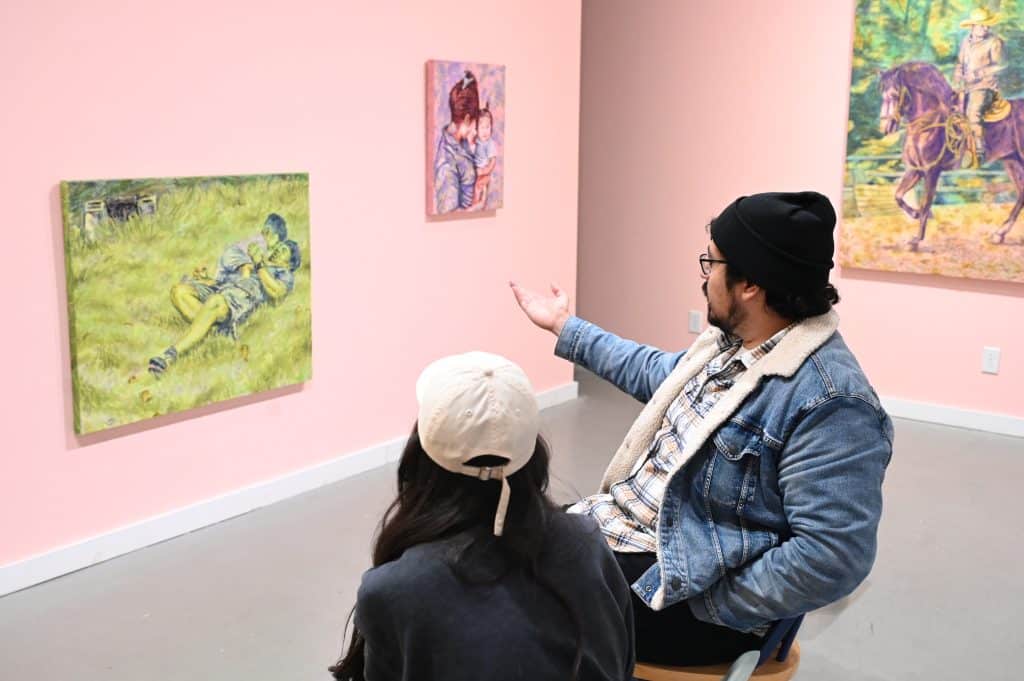
STEPHEN KNIGHT
One of the first things he noticed was how different his Latino identity felt from that of his cousins or Latino friends. He wondered: “Should I have more Latino friends?” or “Should I speak more Spanish outside the home?”
But Morales realized he could enjoy listening to the music of Mexican singer Vicente Fernández, which their parents loved, just as much as sitting down to watch the latest sketches on “Saturday Night Live.”
Morales remembers his childhood and adolescence as a shy, creative kid passionate about theater and stand-up comedy. Meanwhile, his cousins were more interested in soccer, partying with friends, and horseback riding. None of these ways is wrong; they’re all valid.
Art as an archive of family memories
His most recent exhibition at the Tiger Strikes Asteroid gallery, titled “Los de Aquí” (Those From Here), was inspired specifically by the idea of exploring the diverse ways of being Latino within his own diaspora family.
“There’s no one mold of what Latinidad looks like,” Morales said. “The older I’ve gotten, the more OK I’ve been with that, and I wish I could tell that to my younger self.”
More than just an art exhibition, “Los de Aquí” is an archive of memories that rescues not only the stories of Morales’ family, but also those of so many hard-working Latine immigrant families.
The first step Morales took in shaping his exhibition was to visit his family members in Georgia, California and Nevada, to better understand them and observe how they express their Latinidad in daily life. He reconnected with aunts, uncles and cousins he hadn’t seen in years.
Morales photographed his relatives in their everyday environments, capturing what made them unique. He then transferred these images to canvas, adding expressive brushstrokes and colors that create lively interactions between the paintings. His works capture the simplicity of everyday moments and the profound ways Latines imprint their identity onto the places they inhabit.
“Your life can look as simple as loving your family, horseback riding, or just playing games on your phone, whatever. That’s just you living, regardless of what you do. You are still Guatemalan. You are still American. Just don’t pigeonhole us into a place where you think we should act or behave,” Morales said.
A walk through the exhibition
As soon as you enter “Los de Aquí,” it feels as if you’re peering into the windows of his Guatemalan family’s homes in the diaspora.
Paintings on the walls depict his cousin riding a horse in Georgia, another cousin straightening her hair at his aunt’s house in California, another cooking with his wife while their daughter plays peek-a-boo in their California apartment, and even one of a cousin’s home in Las Vegas, where he laughs with friends, holding a bottle of alcohol.
“I like to sometimes think of myself as an archivist for my family,” Morales said. “This is the step of archiving my family’s time in the United States, and what does that look like. I’ll look at these paintings, 50, 60 or 70 years from now, and be like … I know exactly what was going on at that moment.”
One thing that most distinguishes Morales is his ability to explore with materials. In several of his paintings, Morales managed to create an almost sandy texture using dirt he collected while visiting his family. Additionally, all of his pieces are bordered with newspaper clippings about current immigration policies under the Trump administration.
Some of the headlines read, “Judge says gov’t can’t send them to Guatemala — for now” or “L.A. raids aren’t only targeting the ‘worst’.”
This is not the first time Morales has experimented with various materials. In past exhibitions, he has used other media linked to his family’s work in the diaspora, such as garbage bags and concrete, to reference the labor of garbage collectors and the cement industry.
“Los de Aquí” continues the themes explored in his earlier exhibition “Mi Casa Es Mi Casa,” where he depicted the everyday lives of his loved ones at home and reflected on the concept of what makes a house a home. Is it the people who live there, its location, or the sensory experiences — the smells and sounds — that surround it?
The exhibition’s title, “Los de Aquí,” reclaims and challenges the often-repeated phrase “Ni de aquí, ni de allá” — meaning “neither from here, nor there,” a sentiment commonly shared throughout Latin American immigrant communities. The exhibition ran from Sept. 6 to Oct. 18.
Recently, Morales led the Bloque de Oro Textile Murals project on North 5th Street, a key commercial corridor for Philadelphia’s Latino community. That initiative was a collaboration between Mural Arts and the Hispanic Alliance for Career Enhancement.

STEPHEN KNIGHT

Una conversación con Henry Morales: “No existe un solo molde de cómo se ve la latinidad.”
El artista guatemalteco-estadounidense habla sobre cómo la vida cotidiana de su familia en la diáspora se convirtió en la inspiración detrás de su más reciente exposición, “Los de Aquí” (Those From Here).
Por: Némesis Mora
A Henry Morales nunca le pasó por la mente convertirse en artista. Él pensaba que dedicaría su vida al teatro, algo que amó profundamente desde niño. Pero la vida tenía otros planes para él.
Un día, mientras dibujaba durante su descanso en el trabajo, la supervisora de piso vio uno de sus dibujos por primera vez. Impresionada, exclamó: “¡Esto está bello! Deberías estudiar arte”. Como los consejos que vienen de afuera suelen impactar de forma distinta, Morales decidió seguir la sugerencia y darle una oportunidad a las artes.
“Había algo en que viniera de una supervisora que no tenía nada que ver con mi vida”, confesó Morales. “Además, a ella no le caía bien como empleado, y con razón. Así que pensé: quizá debería intentarlo.”
Fue precisamente gracias al arte que se mudó a Filadelfia en 2018, cuando comenzó su licenciatura en Pintura en la Tyler School of Art and Architecture. Para él, Filadelfia fue el eslabón perdido que le permitió conectar más profundamente con su identidad como guatemalteco, habiendo crecido entre Los Ángeles y Las Vegas.
Trasfondo familiar y su perspectiva sobre la Latinidad
A mediados de los años 80, sus padres tomaron la decisión de dejar Guatemala y migrar a Los Ángeles en busca de una vida mejor para ellos y su futura familia. Su madre fue la primera en emigrar, y Morales recuerda con nostalgia los desafíos que enfrentó: empezar de cero, cuidar a su bebé y trabajar largas horas como conserje.
“Siempre es interesante escuchar esas historias de mi mamá. No me puedo imaginar ver o escuchar algo así sin sentir que… ojalá hubiera estado ahí para ti”, compartió Morales.
Pero no fue sino hasta llegar a Las Vegas con su familia que experimentó por primera vez la compleja dualidad de ser latino mientras comenzaba a identificarse con la cultura estadounidense—un conflicto que no comprendía del todo a los 11 años.
Una de las primeras cosas que notó fue lo diferente que se sentía su identidad latina en comparación con la de sus primos o amigos latinos. Se preguntaba: “¿Debería tener más amigos latinos?” o “¿Debería hablar más español fuera de casa?”
Morales descubrió que podía disfrutar tanto de la música del cantante mexicano Vicente Fernández, favorita de sus padres, como de los últimos sketches de Saturday Night Live.
Recuerda su infancia y adolescencia como un periodo marcado por su timidez, creatividad y pasión por el teatro y la comedia stand-up. Por su parte, sus primos se inclinaban más por el fútbol, las fiestas con amigos y la equitación. Sin embargo, afirma que todas estas maneras de ser son igualmente válidas, indiferentemente de tu nacionalidad.
El arte como archivo de la memoria familiar
Su exposición más reciente en la galería Tiger Strikes Asteroid, titulada “Los de Aquí”, surgió precisamente de la idea de explorar las diversas formas de ser latino dentro de su propia familia en la diáspora.
“No existe un solo molde de cómo se ve la latinidad”, dijo Morales. “Mientras más he crecido, más cómodo me siento con esto, y desearía poder decírselo a mi yo más joven”.
Más que una exposición artística, “Los de Aquí” es un archivo de memorias que rescata no solo las historias de la familia Morales, sino también las de tantas familias inmigrantes latine trabajadoras.
El primer paso que dio Morales para darle forma a la exposición fue visitar a sus familiares en Georgia, California y Nevada, con el fin de comprenderlos mejor y observar cómo expresan su latinidad en su vida cotidiana. Allí se reencontró con tías, tíos y primos a quienes no veía desde hacía años.
Morales fotografió a sus familiares en sus propios entornos, capturando lo que los hacía únicos. Luego trasladó esas imágenes al lienzo, añadiendo pinceladas expresivas y colores que generan un diálogo vibrante entre las obras. Sus pinturas retratan la simplicidad de los momentos cotidianos, así como las tantas formas en que las personas latine muestran su identidad en los lugares que habitan.
“Tu vida puede ser tan simple como amar a tu familia, entrenar caballos o jugar en tu teléfono, lo que sea. Eso es simplemente vivir. Eres guatemalteco. Eres estadounidense. No nos encasillen en una idea de cómo creen que debemos actuar o comportarnos”, añadió Morales.
Un recorrido por la exposición
Al entrar a la exposición “Los de Aquí”, sientes como si te asomaras por las ventanas de los hogares de la familia Morales en la diáspora.
Las pinturas muestran a un primo montando a caballo en Georgia; a otra prima alisando su cabello en casa de una tía en California; a otro primo cocinando con su esposa mientras su hija juega “peek-a-boo” en su apartamento; e incluso a un primo en Las Vegas riendo con sus amigos mientras sostiene una botella de alcohol.
“A veces me gusta pensar en mí como el archivista de mi familia”, dijo Morales. “Este es un paso para archivar el tiempo de mi familia en Estados Unidos y cómo fue esa experiencia. Cuando mire estas pinturas dentro de 50, 60 o 70 años, podré decir: sé exactamente lo que sucedía en ese momento.”
Una de las características más distintivas de Morales es la exploración con materiales. En varias de sus pinturas, logró una textura arenosa utilizando tierra recogida durante sus visitas familiares. Además, todas sus obras están enmarcadas con recortes de periódicos sobre las políticas migratorias que se están llevando a cabo bajo la administración de Trump.
Algunos titulares dicen: “El juez afirma que el gobierno no puede enviarlos a Guatemala, por ahora” o “Las redadas en L.A. no se enfocan únicamente en ‘los peores’”.
Esta no es la primera vez que Morales experimenta con materiales diversos. En exposiciones anteriores ha utilizado otros medios vinculados al trabajo de su familia en la diáspora, como bolsas de basura y concreto, para aludir a labores de recolección de basura y a la industria del cemento.
“Los de Aquí” continúa los temas explorados en su exposición previa “Mi Casa Es Mi Casa”, donde retrató la vida cotidiana de sus seres queridos en el hogar y reflexionó sobre qué convierte una casa en un hogar: ¿son las personas que la habitan, el lugar en que se encuentran, o las experiencias sensoriales —los olores y sonidos— que la rodean?
El título “Los de Aquí” retoma y desafía la frase común “Ni de aquí, ni de allá”, un sentimiento ampliamente compartido en comunidades inmigrantes latinoamericanas. La exposición estuvo abierta del 6 de septiembre al 18 de octubre.
Recientemente, Morales lideró el proyecto Bloque de Oro Textile Murals en North 5th Street, un corredor comercial clave para la comunidad latina de Filadelfia. Esta iniciativa fue una colaboración entre Mural Arts y la Hispanic Alliance for Career Enhancement.

Autor(a)